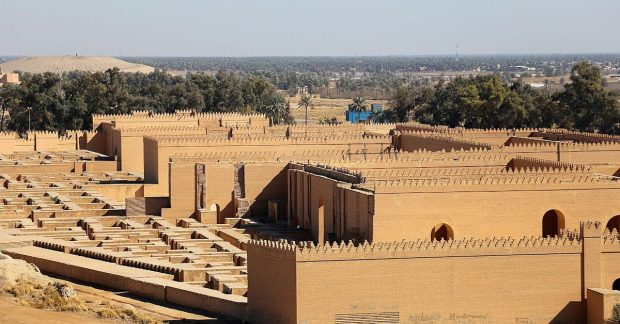
Scientists determine the exact date of the fall of ancient Babylon
An international team of researchers has established a new date for the fall of Babylon by combining radiocarbon wood analysis and volcanic activity data.
 🎭Culture & Sport
Photo: UNIAN
Key points
- Scientists used radiocarbon analysis and data on volcanic eruptions.
- The date of the fall of Babylon is established as 1587 BC.
- Climate changes, specifically droughts, played a role in the decline of great empires.
An international team of researchers led by Charlotte Pearson from the University of Arizona has solved one of history's oldest riddles — the date of the fall of Babylon. For decades, historians have debated the chronology of events in Mesopotamia, proposing various dating models that significantly affected the understanding of civilizational development.
Research methods
To achieve accuracy, the scientists applied a comprehensive approach. They analyzed radiocarbon content in tree rings found in Anatolia and cross-referenced these findings with the Assyrian calendar. A pivotal moment was matching Babylonian records of Venus observations with data on the eruption of the Aniakchak volcano in Alaska, which occurred around 1628–1627 BC.
Results and conclusions
Based on the gathered evidence, the researchers concluded that the fall of Babylon, carried out by the troops of the Hittite king Mursili I, took place approximately in 1587 BC. Furthermore, the analysis revealed a link between prolonged droughts and the decline of the Hittite state, highlighting the impact of climate change on historical processes.
Source UNIAN — unian.ua/science/stalo-vidomo-koli-same-vpav-vavilon-vcheni-rozkril… ↗
Read next
 🛡️Security
Charity auction in Lviv region raises 60 million UAH for Ukrainian defenders
A charity event in the Lviv region successfully raised 60 million UAH to purchase drones and support the rehabilitation of a wounded veteran.
 🏛️Politics
Russian missiles breach Polish airspace: incident details
Polish authorities have labeled the landing of Russian missiles and a drone on their territory as a deliberate provocation.
 🚌Transport
Nighttime UAV attack: threat to southern districts of Odesa region
On the night of November 23, enemy drones moved from the Black Sea towards Tatarbunary and the Kiliya district.
 🏙️City
How to keep your home warm: simple tips for Kilia residents ahead of the winter season
As temperatures drop, energy efficiency becomes a priority. Scandinavian hacks can help minimize heat loss without significant expenses.
 🛡️Security
Investigation in Poland: New details on Russian missiles revealed
Polish investigators have determined that three Russian Kh-101 missiles that violated the country's airspace were manufactured in late 2026.
 🛡️Security
Tragedy in Dymer: death toll from Russian attack rises to seven
Rescuers have recovered another body from the rubble of a five-story building in Dymer struck by a Russian drone.